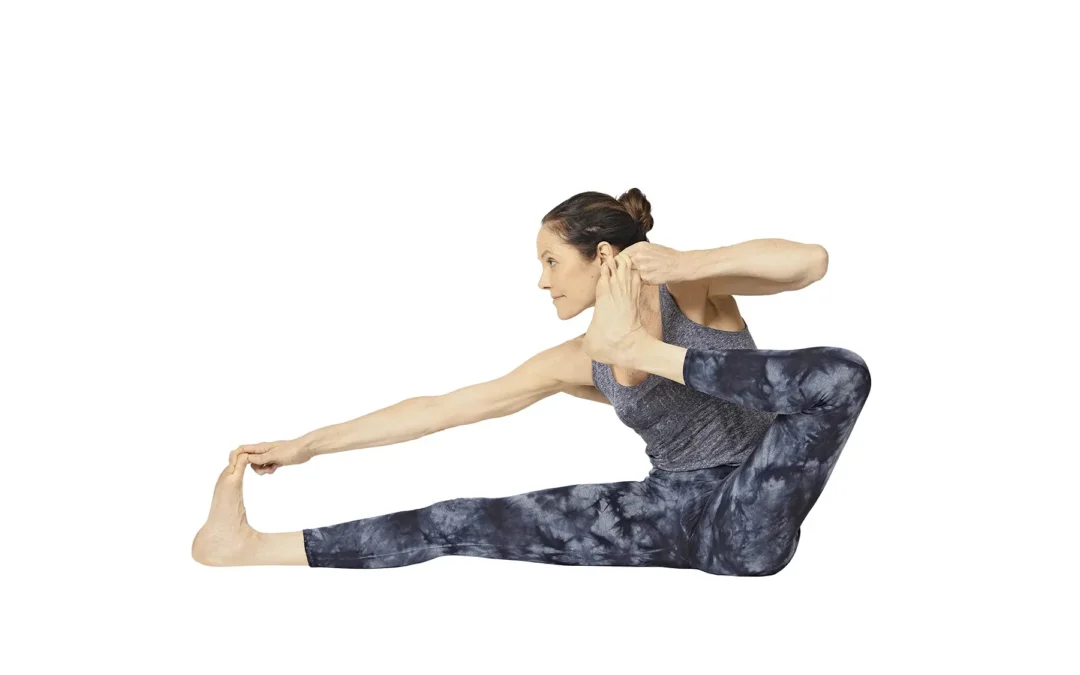
Those who have practiced archery at some point, may be well-acquainted with this term. It is one of the most effective seated poses in yoga, since old times. In this pose, the practitioner takes up the stance of pulling a bow. Most yoga beginners may not be aware of this pose. As it is of an advanced level. If you happen to join the 200 hour kundalini yoga teacher training in Bali, you will get to learn this.
For now, you can read about the steps to progress through the pose, learn about its benefits, and also know about variations.
Step-By-Step Guide To Akarna Dhanurasana
But, beforehand, let us know about the meaning. ‘Akarna’ means ‘towards ear’, ‘Dhanur’ means ‘archery’, and ‘Asana’ means ‘pose’. Now, let us start with the steps.
- You have to start in the Dandasana pose. Sit on the mat, with both legs extended straight outwards. Your feet should be together. Place both hands beside your hips. The fingers will be pointing forward.
- After you get into the above position, you have to engage the thigh muscles, tighten the foot muscles, and push the heels downwards. You must focus on the spine, lengthening it, rolling the shoulders backwards, and also opening up the chest.
- After you have taken a position, you must bend the right knee and lean in front. Then, one must hook the big toe of the right leg with the right hand’s index finger, middle finger and thumb. Then stretch the left hand and hold the big toe of the left foot.
- When you have taken the above position, it is important to breathe properly. Slowly, pull the left foot with the finger lock intact, towards the left ear. Keep the right leg straight. Imagine that you are drawing a bow string.
- In this pose, the left arm is the string and the right leg is the bow. You can hold the pose for 5-10 breaths.
- Slowly release yourself from the pose. Exhale slowly, and return the left foot to the floor. You have to move into the Dandasana again. Pause and breathe freely.
- You have to repeat the same thing on the opposite side.
The yoga school in Rishikesh will help you to learn and perfect the pose. Now, let us understand the variations.
Variations Of The Archer’s Pose
Now, many yoga students or rather practitioners, may have a problem learning and practicing new yoga poses. So, in such cases, one can practice the variations.
- Full Akarna Dhanurasana – This is the main pose discussed above. The main challenge with this pose is keeping the leg straight.
- Forward Fold Variation – May yogis also call it the Parsva Akarna Dhanurasana. In this, you are required to fold the body forward, over the extended leg. Thereafter, you must bring the nose in contact with the shin of the stretched leg. The foot is pulled towards the ear.
- Dynamic Akarna Dhanurasana – This is another variation, better known as the bow and arrow motion. When you pull the right leg towards the ear in this pose, imagine holding an arrow, which is your outstretched left hand. Inhale and open the chest, and while exhaling, pull the foot closer. Repeat this a few times, on each side.
- Bound Akarna Dhanurasana – You can also hear this being referred to as Baddha Akarna Dhanurasana. In this you have to start in the classic pose, and then take the opposite hand behind the back. So, basically the right foot is in the right hand, whereas the left arm is behind, while holding the right foot. Deepen the hip stretch and open the shoulder well.
Benefits Of Akarna Dhanurasana
You can join the 200 hour kundalini yoga teacher training in Bali to learn about the process. On the other hand, you can also understand the benefits further.
- This asana or pose gives a deep stretch to the hips and the hamstrings.
- It also strengthens the back muscles and the core muscles.
- It also improves balance and co-ordination.
- It stimulates the digestive organs.
- It boosts mental focus and concentration.
Take Away…
Join the best yoga school in Rishikesh to learn about this advanced asana called Archer’s Pose. It is important to go about the pose as per the instructions of the teacher. Then only, you reap maximum benefits out of it.